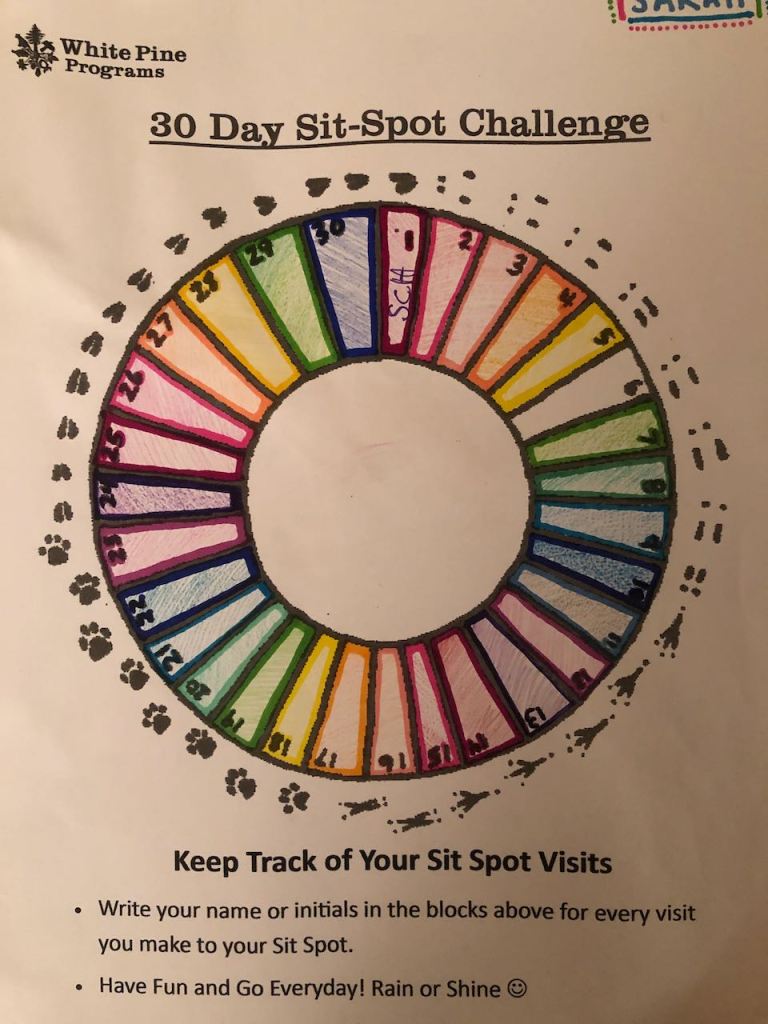
30 days. A fraction of a lifetime. A snapshot between seasons. In this case, mud season, as it’s affectionately known in Maine. That brownish, grayish period after the snow melts and before any green leaves appear.
I completed my sit-spot challenge between March 23 – April 23, 2020. I sat in my sit-spot (defined as a spot anywhere in or near nature) for ~25 minutes each day for 30 days, no matter the weather. Each day I brought with me a camp chair, notebook, and pen. Phone on airplane mode, only to be used as a timer. A thermos of tea on the colder days. I wore snow pants or rain boots as needed (did I mention this was rain or snow or shine?), but it was early enough in the year that I didn’t need a mosquito net.
I chose a spot in the woods behind the house I grew up in. I hadn’t lived in my childhood home full time since 2003, but the house had always been there for me during school vacations or when I was between countries or cities during my adult life.
My house in the woods was there for me again that memorable March. While life in the outside world had been put on hold, life in the forest behind my childhood home in Maine kept on as usual.
Days 1-7
My sit-spot was not deep in the woods, but far enough that I could face away from the house and have nothing man-made in my sight line. I sat beside a vernal pool and narrow stream surrounded by trees, including three that had fallen haphazardly to frame the pool, downhill from a rocky outcrop where we had attempted to sled in elementary school (it didn’t go that well – too bumpy).
My journal entries during the first week are detailed and fill up entire pages. How else was I to get through 25 minutes with just myself for company? I describe various patterns of bubbles floating down the stream. I note bird calls, or a lack thereof. I muse about the many trees and the fallen, dead leaves covering the ground. I keep myself occupied by brainstorming the perfect name for the tree I sit under, and christen the tree ‘Sherlock.’ Sherlock’s sparse branches keep me vaguely sheltered from the elements.
I keep busy recording the details of what I notice around me, figuring out how to pass those 25 minutes. Each day the entries uncover another layer of the forest around me.
Over that first week my description of Sherlock evolves from the broad term ‘evergreen’ to a ‘hemlock’ to a tree having ‘needles like tiny dissected cucumbers’. I forget there was a time when I didn’t know a hemlock from a white pine (and they look very different, so it’s not a tricky choice). But there was a time and that time wasn’t that long ago. How had I grown up on that land and not known which trees on “Hemlock Ridge” were hemlocks? The priorities and distractions of youth.
I start to notice the daily changes to the water, the colors, the air. I wonder why they’ve occurred. I begin using all my senses. I realize I hear the wind first before seeing some trees sway in its presence.
Day 5 was a seminal day. The sun was out that warm, spring day and my sit-spot was hopeful. Spider webs and pine needles glistened, catching the light. I write about our housemates’ walk to York Pond and the many things I learned about beech tree leaves and May flowers (aka trailing arbutus). My dear housemate Jen gifted me a beautiful hemlock bough with delicate cones on one end that she found hanging from a beech tree’s branches, which finds a new home around my sit-spot.
The rain comes quickly after that sunny day. With it comes the discovery of bright, sage-colored lichen on all the trees and new bubble patterns in the stream. Raindrops cling precariously to Sherlock’s needles around and above me, but they seem to hold fast and tight; a slight breeze does not jostle them. I spot a mushroom for the first time nearby. I’m not fully cognizant of the connection between the rain, the lichen and the fungi yet, but it sparks my curiosity.
Days 8-14
Spring buds are seen in other parts of the woods, but not at my sit-spot. Tree branches are still naked, swaying bare under the gray sky. But, at least the lichen is thriving in the shade.
I write a poem (my first ever?):
These woods
That I grew up in
Visited for 26 years
Are slowly revealing their essence to me
Not secrets
They were never hiding anything
I just wasn’t paying attention
I wasn’t looking
Listening
Letting the forest share its true nature
With me.
I decide to move upstream about 10 feet, and I turn to face north to get a better vantage point, with the rocky outcropping to my back. I can still wave to Sherlock.
On day 12 I write, “I felt like the forest was opening up to me today”. I remember that my need to fill the time by busily writing minute observations started to subside around that time. It was like sitting comfortably with a friend. I’d gotten to the point where I didn’t need to fill up the time with words and instead could just sit together with the trees.
My sense of hearing comes to the foreground. I notice man-made sounds in the distance, which I no longer take for granted as background noise. In a time of isolation, auditory proof of other humans was especially noteworthy. I hear new bird melodies interspersed with plane traffic. On sunny days the wood frogs cause a ruckus, sharing my happiness in the sun’s warmth.
I start to hear multiple currents in the stream on sunny days as well, once the raindrops stop overshadowing them. The sounds of flowing water allow for two states of mind. When thoughts are meant to be contemplated, the stream can be a relaxing and steady background for daydreaming. When a meditative focus is preferred, I can instead be present with the natural sights and sounds. The complete lack of digital distractions is a boon for being alone with my thoughts. Well, not entirely alone. The birds sing, the wind blows and the stream babbles.
I accidentally write, “I’m the trees…” which shows the state of mind I was getting into.
Days 15-21
Halfway through the challenge, and spring is finally arriving in the form of tiny buds on some of the tree branches. The trees are so patient, while I can’t wait for the buds to grow into green leaves.
I’ve transitioned into the ‘less is more’ style in my notebook, preferring stillness over writing. I do highlight a few things that catch my eye: Noseeums. Woodpeckers. The color of lichen that pops and mesmerizes my sight on rainy days. Fascinating patterns of bubbles and foam that make me positively giddy the day I bring my binoculars and observe them up close.
I’m reminded of the strength of mother nature when big winds roll through the trees, causing them to lean to precarious angles while squeaking and creaking. Despite my growing comfort at my sit-spot, this makes me nervous and I’m alert for falling tree branches. There is actually a limit to the type of weather to sit-spot in. Safety first.
Days 22-29
I break a rule and on day 23 I allow myself a book: Upstream by Mary Oliver. Did I want a distraction from my thoughts that day, worried the woods wouldn’t be enough? Or had the forest embraced me to feel comfortable doing everyday activities? I don’t know.
Journal entries continue to shorten to a third, a quarter of a page. I was anxious to get back to ‘real life’ and out of quarantine. The trees still seemed so bare and it made me feel sad and desperate. Would the green leaves ever arrive?
Day 30
The final day is emotion filled. It’s peaceful and quiet at first. The stream has slowed to a trickle. I hear an airplane and the neighbor’s dogs barking, signals of civilization continuing outside the homestead. I hear multiple bird songs. Finally, I look up to my right at the stately trees that had been so patient all winter. The tips of the branches look rounder, fuller. I peer through my binoculars and catch my breath as I see the buds peaking out in front of the blue sky. I write a tearful journal entry about hope and the feeling that nature knows its time. And then my curious, scientific brain overtakes the emotion as I write the last line: How do I know if these trees are maples or oaks?
On other days mechanical noises were an intrusion, but on that last day, the airplane overhead reminds me that what we call civilization continues and that comforts me. However, it’s the inherent knowledge of nature and the trees that gives me hope.
2023
Now, three (!) years later, I feel many emotions reading the last entry. That realization that the pandemic would last longer than a few weeks and that we were in it for the long haul was settling over us around that time. I had been back in Maine for over a month and I missed my friends. I missed my life in Chicago.
And yet. Today I miss the bough beneath Sherlock. I’m still fascinated by the bright lichen amid the rain and the bubbles in the stream. I can hear and see and feel the wind in those trees.
I had been welcomed back home by the forest and given refuge in a time of need. I felt comfortable and safe there. Nine months after I completed my sit-spot challenge, I celebrated my January birthday on a balmy, 30F degree evening. We sat outdoors around a campfire in the woods, quite close to my sit-spot, with vegetable curry and mulled wine and chocolate cake and new family/friends.
Eventually I moved away and said goodbye to those woods for the last time. But, those woods will always be a part of me. They’ve affected how I move through nature and get to know each place I call home.
I am forever thankful for, and forever changed by, my 30 days in the woods.
 Sarah Clark-Hamel
Excellent entry Sarah, I enjoyed reading about your sit spot and time communing with Sherlock and the woods of York. Thank you for sharing this!
-Sean
LikeLike