The first time I spotted San Francisco’s skyline from the side of Mt Tam, I felt like Dorothy when she first glimpsed Oz from the Yellow Brick Road.
That same enchanted surprise stopped me in my tracks on a crystal clear day in the Pedro Point Headlands. On a trail that’s normally shrouded in fog, I rounded the bluff to a vision of the Golden Gate Bridge and Sutro Tower rising up from the city’s hills. Further north I saw mountains upon mountains lining the Pacific.
It comes as a beautiful surprise no matter how many times I’ve caught this view from the north/east/south. Whether the city is peering out from the fog or standing proud in sunshine, there’s something magical, ethereal, awe-inspiring, about this city on the bay.
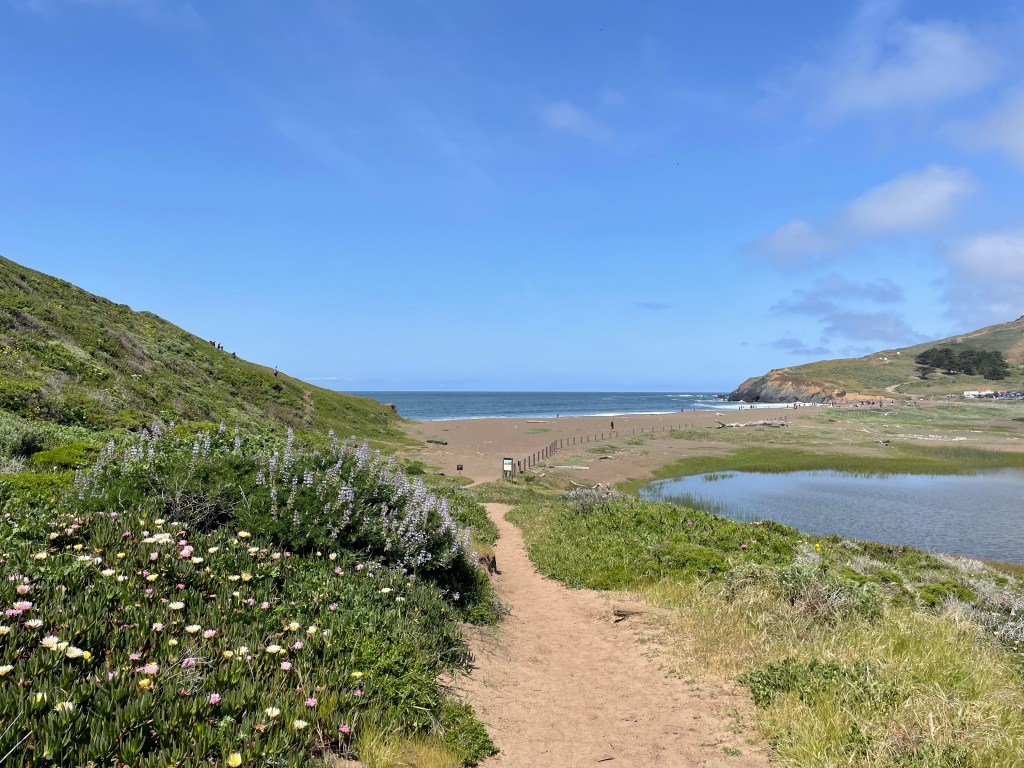
The Marin headlands were in fine form today.
My breath taken away and given back by
Salt air.
Sunshine.
Wildflowers. Waves.

Sometimes living here breaks my heart.
And then suddenly I’m looking at the sea,
the mountains at my back,
supporting me,
safe and whole.
If only I could stay on that beach forever.
Last summer I went to a yoga studio in the Mission. After a rushed bike ride and huffing up five flights of stairs, I emerged into a bright, expansive studio. Wall-to-wall windows opened to hills, sunshine, and rooftops. A jungle of plants hung from the ceiling. I smelled my favorite teakwood & tobacco candle. I heard soft instrumental music. My senses were captured and I was present.
Everyone looked content in the best meaning of the word, like that was exactly where they were meant to be at that moment. The instructor asked us to introduce ourselves to a neighbor which felt daunting yet energizing.
I settled onto my mat and with the first unified breaths I clicked in. I’d like to say my mind stayed still throughout class, but it never does. My thoughts then wandered and wondered if this could be a classic yoga meet-cute with my mat neighbor and if I would have been self-conscious if I had worn just a sports bra and why the hell my foot hurt so much.
But then, the cues my new teacher gave kept bringing me back to the present. They made me feel more in each pose. More in tune, more aligned. Each pose and cue reminded my body, “oh, this is what home feels like”. This is how each pose builds upon the other. I felt each muscle warming and easing deeper into poses until we reached our peak and then cooled back down together.
Everyone in that room was right where they belonged. I was at home.
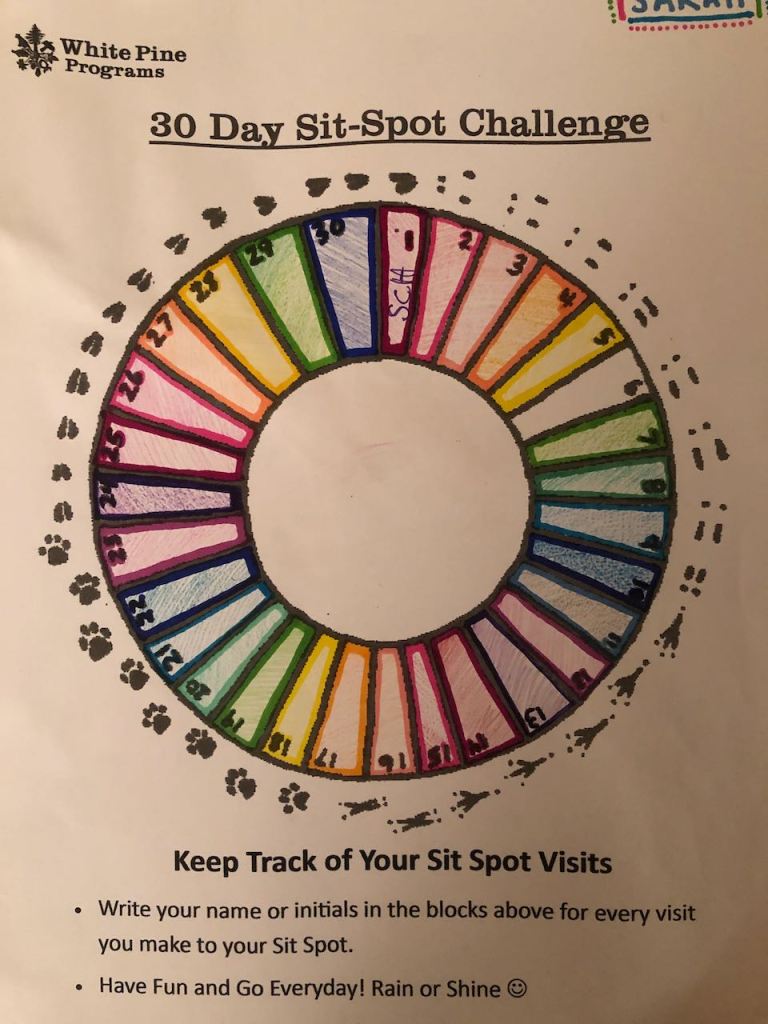
I only partake in challenges that involve stickers or colored pencils.
30 days. A fraction of a lifetime. A snapshot between seasons. In this case, mud season, as it’s affectionately known in Maine. That brownish, grayish period after the snow melts and before any green leaves appear.
I completed my sit-spot challenge between March 23 – April 23, 2020. I sat in my sit-spot (defined as a spot anywhere in or near nature) for ~25 minutes each day for 30 days, no matter the weather. Each day I brought with me a camp chair, notebook, and pen. Phone on airplane mode, only to be used as a timer. A thermos of tea on the colder days. I wore snow pants or rain boots as needed (did I mention this was rain or snow or shine?), but it was early enough in the year that I didn’t need a mosquito net.
I chose a spot in the woods behind the house I grew up in. I hadn’t lived in my childhood home full time since 2003, but the house had always been there for me during school vacations or when I was between countries or cities during my adult life.
My house in the woods was there for me again that memorable March. While life in the outside world had been put on hold, life in the forest behind my childhood home in Maine kept on as usual.
Days 1-7
My sit-spot was not deep in the woods, but far enough that I could face away from the house and have nothing man-made in my sight line. I sat beside a vernal pool and narrow stream surrounded by trees, including three that had fallen haphazardly to frame the pool, downhill from a rocky outcrop where we had attempted to sled in elementary school (it didn’t go that well – too bumpy).
My journal entries during the first week are detailed and fill up entire pages. How else was I to get through 25 minutes with just myself for company? I describe various patterns of bubbles floating down the stream. I note bird calls, or a lack thereof. I muse about the many trees and the fallen, dead leaves covering the ground. I keep myself occupied by brainstorming the perfect name for the tree I sit under, and christen the tree ‘Sherlock.’ Sherlock’s sparse branches keep me vaguely sheltered from the elements.
I keep busy recording the details of what I notice around me, figuring out how to pass those 25 minutes. Each day the entries uncover another layer of the forest around me.
Over that first week my description of Sherlock evolves from the broad term ‘evergreen’ to a ‘hemlock’ to a tree having ‘needles like tiny dissected cucumbers’. I forget there was a time when I didn’t know a hemlock from a white pine (and they look very different, so it’s not a tricky choice). But there was a time and that time wasn’t that long ago. How had I grown up on that land and not known which trees on “Hemlock Ridge” were hemlocks? The priorities and distractions of youth.
I start to notice the daily changes to the water, the colors, the air. I wonder why they’ve occurred. I begin using all my senses. I realize I hear the wind first before seeing some trees sway in its presence.
Day 5 was a seminal day. The sun was out that warm, spring day and my sit-spot was hopeful. Spider webs and pine needles glistened, catching the light. I write about our housemates’ walk to York Pond and the many things I learned about beech tree leaves and May flowers (aka trailing arbutus). My dear housemate Jen gifted me a beautiful hemlock bough with delicate cones on one end that she found hanging from a beech tree’s branches, which finds a new home around my sit-spot.
The rain comes quickly after that sunny day. With it comes the discovery of bright, sage-colored lichen on all the trees and new bubble patterns in the stream. Raindrops cling precariously to Sherlock’s needles around and above me, but they seem to hold fast and tight; a slight breeze does not jostle them. I spot a mushroom for the first time nearby. I’m not fully cognizant of the connection between the rain, the lichen and the fungi yet, but it sparks my curiosity.
Days 8-14
Spring buds are seen in other parts of the woods, but not at my sit-spot. Tree branches are still naked, swaying bare under the gray sky. But, at least the lichen is thriving in the shade.
I write a poem (my first ever?):
These woods That I grew up in Visited for 26 years Are slowly revealing their essence to me Not secrets They were never hiding anything I just wasn’t paying attention I wasn’t looking Listening Letting the forest share its true nature With me.
I decide to move upstream about 10 feet, and I turn to face north to get a better vantage point, with the rocky outcropping to my back. I can still wave to Sherlock.
On day 12 I write, “I felt like the forest was opening up to me today”. I remember that my need to fill the time by busily writing minute observations started to subside around that time. It was like sitting comfortably with a friend. I’d gotten to the point where I didn’t need to fill up the time with words and instead could just sit together with the trees.
My sense of hearing comes to the foreground. I notice man-made sounds in the distance, which I no longer take for granted as background noise. In a time of isolation, auditory proof of other humans was especially noteworthy. I hear new bird melodies interspersed with plane traffic. On sunny days the wood frogs cause a ruckus, sharing my happiness in the sun’s warmth.
I start to hear multiple currents in the stream on sunny days as well, once the raindrops stop overshadowing them. The sounds of flowing water allow for two states of mind. When thoughts are meant to be contemplated, the stream can be a relaxing and steady background for daydreaming. When a meditative focus is preferred, I can instead be present with the natural sights and sounds. The complete lack of digital distractions is a boon for being alone with my thoughts. Well, not entirely alone. The birds sing, the wind blows and the stream babbles.
I accidentally write, “I’m the trees…” which shows the state of mind I was getting into.
Days 15-21
Halfway through the challenge, and spring is finally arriving in the form of tiny buds on some of the tree branches. The trees are so patient, while I can’t wait for the buds to grow into green leaves.
I’ve transitioned into the ‘less is more’ style in my notebook, preferring stillness over writing. I do highlight a few things that catch my eye: Noseeums. Woodpeckers. The color of lichen that pops and mesmerizes my sight on rainy days. Fascinating patterns of bubbles and foam that make me positively giddy the day I bring my binoculars and observe them up close.
I’m reminded of the strength of mother nature when big winds roll through the trees, causing them to lean to precarious angles while squeaking and creaking. Despite my growing comfort at my sit-spot, this makes me nervous and I’m alert for falling tree branches. There is actually a limit to the type of weather to sit-spot in. Safety first.
Days 22-29
I break a rule and on day 23 I allow myself a book: Upstream by Mary Oliver. Did I want a distraction from my thoughts that day, worried the woods wouldn’t be enough? Or had the forest embraced me to feel comfortable doing everyday activities? I don’t know.
Journal entries continue to shorten to a third, a quarter of a page. I was anxious to get back to ‘real life’ and out of quarantine. The trees still seemed so bare and it made me feel sad and desperate. Would the green leaves ever arrive?
Day 30
The final day is emotion filled. It’s peaceful and quiet at first. The stream has slowed to a trickle. I hear an airplane and the neighbor’s dogs barking, signals of civilization continuing outside the homestead. I hear multiple bird songs. Finally, I look up to my right at the stately trees that had been so patient all winter. The tips of the branches look rounder, fuller. I peer through my binoculars and catch my breath as I see the buds peaking out in front of the blue sky. I write a tearful journal entry about hope and the feeling that nature knows its time. And then my curious, scientific brain overtakes the emotion as I write the last line: How do I know if these trees are maples or oaks?
On other days mechanical noises were an intrusion, but on that last day, the airplane overhead reminds me that what we call civilization continues and that comforts me. However, it’s the inherent knowledge of nature and the trees that gives me hope.
2023
Now, three (!) years later, I feel many emotions reading the last entry. That realization that the pandemic would last longer than a few weeks and that we were in it for the long haul was settling over us around that time. I had been back in Maine for over a month and I missed my friends. I missed my life in Chicago.
And yet. Today I miss the bough beneath Sherlock. I’m still fascinated by the bright lichen amid the rain and the bubbles in the stream. I can hear and see and feel the wind in those trees.
I had been welcomed back home by the forest and given refuge in a time of need. I felt comfortable and safe there. Nine months after I completed my sit-spot challenge, I celebrated my January birthday on a balmy, 30F degree evening. We sat outdoors around a campfire in the woods, quite close to my sit-spot, with vegetable curry and mulled wine and chocolate cake and new family/friends.
Eventually I moved away and said goodbye to those woods for the last time. But, those woods will always be a part of me. They’ve affected how I move through nature and get to know each place I call home.
I am forever thankful for, and forever changed by, my 30 days in the woods.
My favorite New Yorker cartoon. Let’s try to avoid this future, shall we?
*Disclaimer: This is just one gal’s view on a topic that happens to do with money (and not to be construed as investment advice)*
Full of idealism as I started my career in finance, I wanted to learn everything I could about this mysterious “sustainable investing.” In the early 2010s there were many preconceived notions around this topic. I wanted to get to the bottom of it to inform both my career path and my own investing choices. I felt a disconnect: Why did I recycle and compost and buy organic, but still invest in companies that polluted rivers or treated their workers like garbage?
How could I make sense of my options as a new investor with a 401(k)? Making an informed choice about incorporating sustainability into investments, or having any choice at all, was a serious challenge.
While I am no longer an investment professional, I still care deeply about sustainability and capital markets. I am thrilled at the progress that has taken sustainable investing from niche to mainstream over the past 10 years (see letters written by Larry Fink (CEO of the company that manages the ubiquitous iShares ETFs) for further proof of acceptance). The current availability of sustainable products for the average investor delights me.
However, sustainable investing is not all green grass and blue skies.
Serious challenges persist, such as greenwashing and confusion around myriad definitions and strategies. I know how perplexing this topic can be amongst consumers and professionals alike, especially as (debunked) myths persist. On top of that, it may seem daunting to figure out how to incorporate sustainability into a topic that makes your eyes glaze over.
I’m here to clear some of the fog from around this subject. Below, I outline what those of us dipping our toes in the water of sustainable investing should know, why we should care, and what we can (realistically) do about it.
Question 1: What the hell is sustainable investing?
In a nutshell: sustainable investing is an investment discipline that considers environmental, social, and corporate governance (ESG) criteria to generate long-term competitive financial returns and positive societal impact. (USSIF).
Wait… this doesn’t mean you have to give up returns? The research says no, not if you don’t want to. You can care about profits, people, and the planet, all at the same time. Yay for (conscious) capitalism!
Terms used interchangeably with sustainable investing are ESG, values-based or socially responsible, green or eco-friendly, or impact investing. These all have the same bottom line: you can care about other aspects of a company’s performance besides just financial metrics.
I like to divide sustainable investing into three main branches: negative screening, ESG integration, and impact investing.
(1) Negative screening
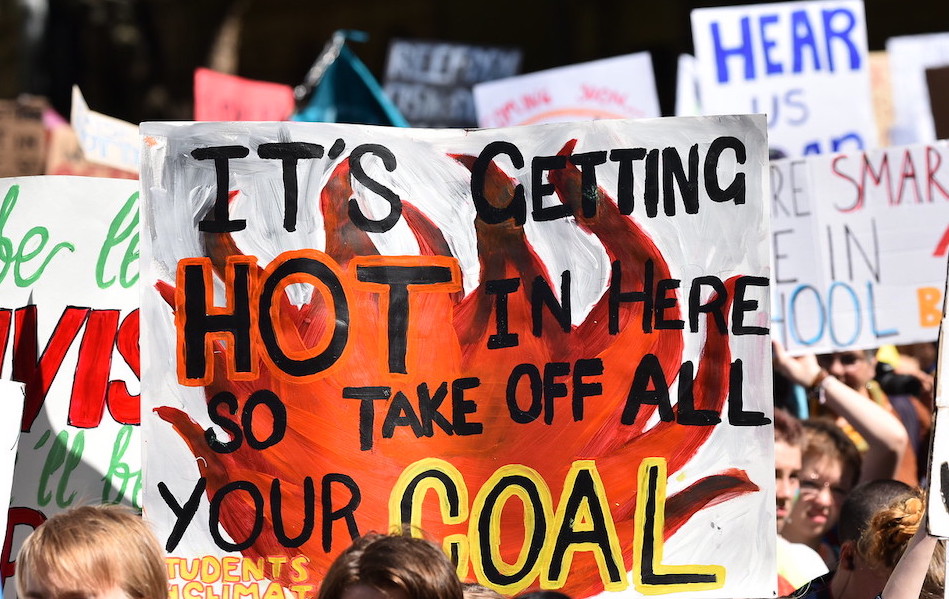
Don’t invest in certain industries or companies, period. Another term for this is divestment (similar idea to a boycott). Traditionally, this tactic was applied to “sin stocks” like alcohol, tobacco, firearms, etc. You will often hear negative screening discussed around “values-based investing.”
Image via School Strike 4 Climate / Flickr
Famous divestment campaigns include divesting from companies in South Africa during the anti-apartheid movement. Recently, environmental activist campaigns that promote divestment from fossil fuels have gained popularity, particularly at colleges and universities. There is hot debate about whether divestment works, or if shareholder engagement (when investors engage directly with companies on ESG issues) is a more effective strategy
(2) ESG Integration
Invest in companies that incorporate environmental, social, and corporate governance insights into their decision-making. One can invest in any industry, but in the top-performing companies within each industry. This aspect of sustainable investing has evolved and become more sophisticated. The robust research conducted and the availability of sustainability-related corporate disclosures have played key roles. Who would have thought that the websites of the largest oil & gas companies would one day highlight plans to combat the climate crisis? It’s a wild world we live in.
(3) Impact investing
Invest in companies whose main goal is to have a positive social or environmental impact through their products/services. The Impact Engine’s blog post on the Spectrum of Impact Investing outlines where impact investing fits in between traditional investing and philanthropy. Typically, impact investing has been geared toward early-stage or smaller ventures, but companies with an environmental or social mission are growing like gangbusters. A conscious consumer loves to see it.
One example of our breathtaking planet this winter. #nofilter
Question 2: Why do my investing choices matter?
We should all do our part to take care of our beautiful home planet. Let’s make sure corporations know this too.
We consumers can vote with our wallets in order to show brands how we feel about their products. This concept applies whether you’re making tangible choices like buying local broccoli or an organic cotton t-shirt, or exploring the intangibility of the stock market. If you own stock in a company, it means exactly that: you are an owner (even if it’s a tiny percentage). So own it!
Make your voice heard. If you don’t buy mass-produced meat from Company Z because of its effect on the environment, you don’t have to support Z by investing your hard-earned money in it either. Or, keep investing in Company Z, but use that ownership for good by letting Z know how you feel about the way it does business.
Don’t these choices make you feel powerful?
Question 3: What can I do about it?
You can find the best option for your personal finances and values. Ask a professional (or google) about what choices are available to you. Below are some guiding questions to get you started. The more financial advisors hear from clients about sustainability and impact, the more informed the advisors will have to become.
Cash: Where are your checking and savings accounts? Is it a local or national bank? Do you know about the bank’s other activities or mission?
Stocks/bonds (i.e. what’s in most 401(k)/IRAs): Does your financial institution show ESG or sustainability ratings for your investments? Do they have research or reports on sustainable investing? Are sustainable or ESG-themed ETFs or mutual funds available? Is it clear whether negative screening (divestment) or shareholder engagement on ESG topics are utilized?
Alternative Investments: If you’ve taken your investments to the next level and are interested in private equity or venture capital, you can ask the same questions about environmental and social impact considerations. Some of the largest PE firms have started impact investment funds, but there are also boutique firms that specialize in impact investing. You may find options like local angel investor circles to your liking. Ask around and see what’s happening in your area.
Is the sustainable investing industry perfect? No. Is greenwashing an issue? Yes. Should that stop you from investing in sustainable products? I think not. Ask questions, do some research, and try to keep the cynicism at bay. When I feel cracks in my idealism, I remind myself that our collective voices have made, and will continue to make, a difference in this space.
Ah, the holidays. The most wonderful, consumeristic time of the year. Trees are chopped down or made from plastic and decorated with more plastic. Electricity usage balloons with light displays that envy Las Vegas. Consumer goods are bought, gifted, then stuffed in the back of a closet.
And yet, I find holiday traditions absolutely magical! Listening to Bing Crosby’s Christmas Classics while hanging ornaments. Watching Elf and White Christmas for the millionth time. Attending The Nutcracker. And who could forget the presents? Nonetheless, as I’ve grown from sipping hot chocolate to toasting with mulled wine, my understanding of how to celebrate the holiday has evolved as well.
As a child, receiving gifts wrapped in the Sunday newspaper’s comics section, or saving gift bows for my grandmother to reuse year after year, seemed like family quirks. I began to understand the environmental significance of these small annual acts as I started to understand the bigger picture of consumerism and waste.
There are many ways to have a greener holiday, evidenced by the plethora of eco-friendly and sustainable gift guides online. However, many of these lists imply that you need to BUY new things to show your loved ones that you care. Spoiler alert: you don’t.
In an effort to be not just another list, I thought I would highlight how I’ve tried, slowly but surely, to “greenify” my own holidays. Although this post is about Christmas, the basic principles can be applied to any gift-giving or decoration-infused holiday.
The Tree.
This year, I took on the chief holiday task of tree selection.
I did my research. I learned that Balsam Firs smell more “christmasy” but the Fraser Firs retain their needles better. However, my newfound knowledge was not applicable this year because of the Christmas tree shortage! (Fascinating story of supply/demand mismatch.)
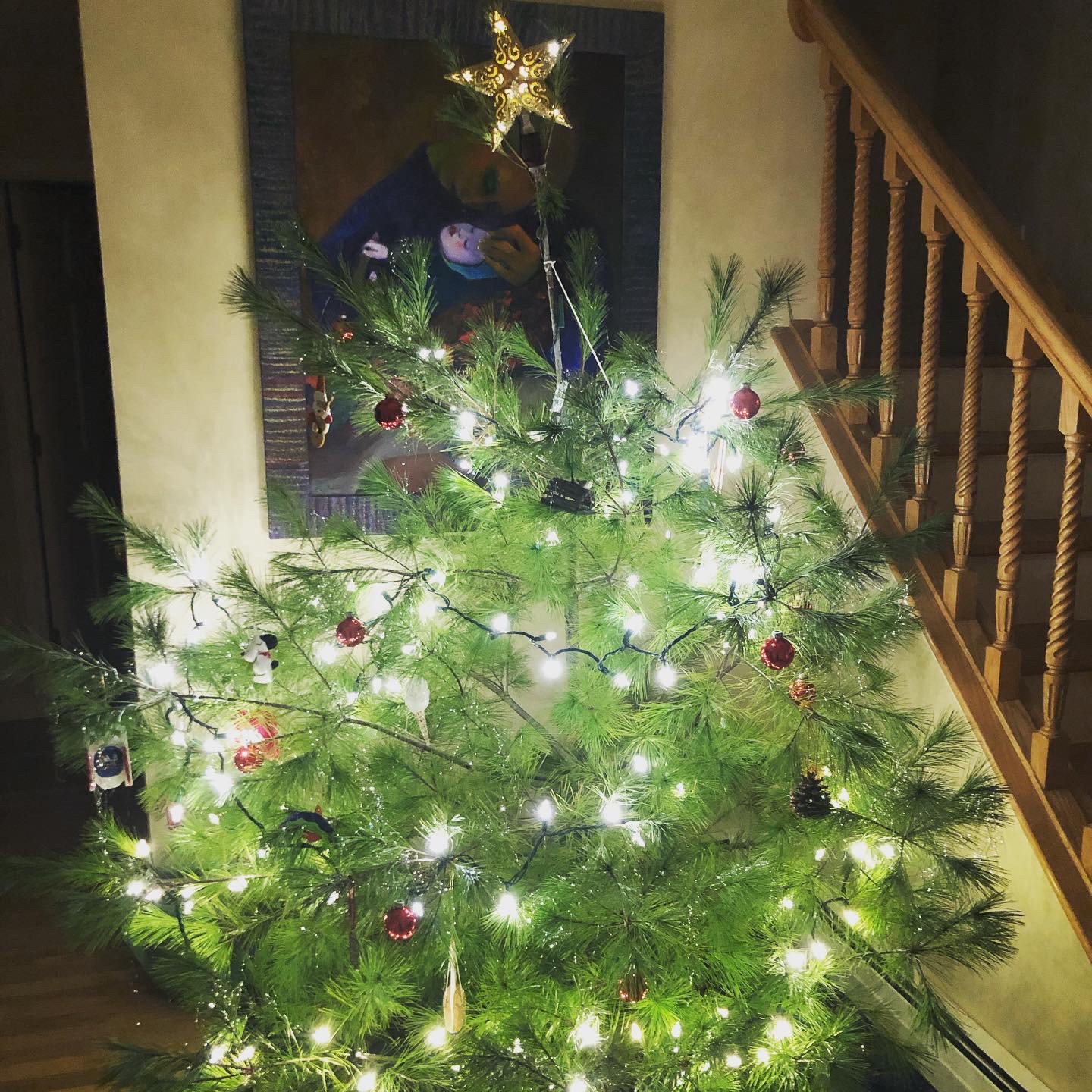
I was not-so-secretly ecstatic about this outcome. I had actually wanted to cut down a tree behind the house and have our very own “Charlie Brown” tree. Because we are lucky enough to live in the woods and own loppers to cut down a bushy young tree: I got my wish.
Snoopy Bulger, the White Pine Tree
The real versus fake tree debate is ongoing. Although I will always be a “real tree” kind of gal, reusable plastic trees make more sense in many homes. There are a few articles (examples here and here) about life cycle analyses that have been done. The basic principles of Reduce/Reuse/Recycle apply for either tree type.
Fake Tree: Reuse year after year to justify the plastic consumption and reduce the amount that ends up in landfills.
Real Tree: Buy from a local tree farm (if possible) and dispose with care at the end of the season to be made into mulch or to biodegrade in the woods. .
The Decorations.
Reuse, recycle, and get creative.
Need to purchase new strings of lights because the old ones mysteriously turn off at odd hours? An investment in LED Christmas lights may be worth it. They use less energy (lowering your electricity consumption and bill) and last much longer than the cheap, incandescent lights.
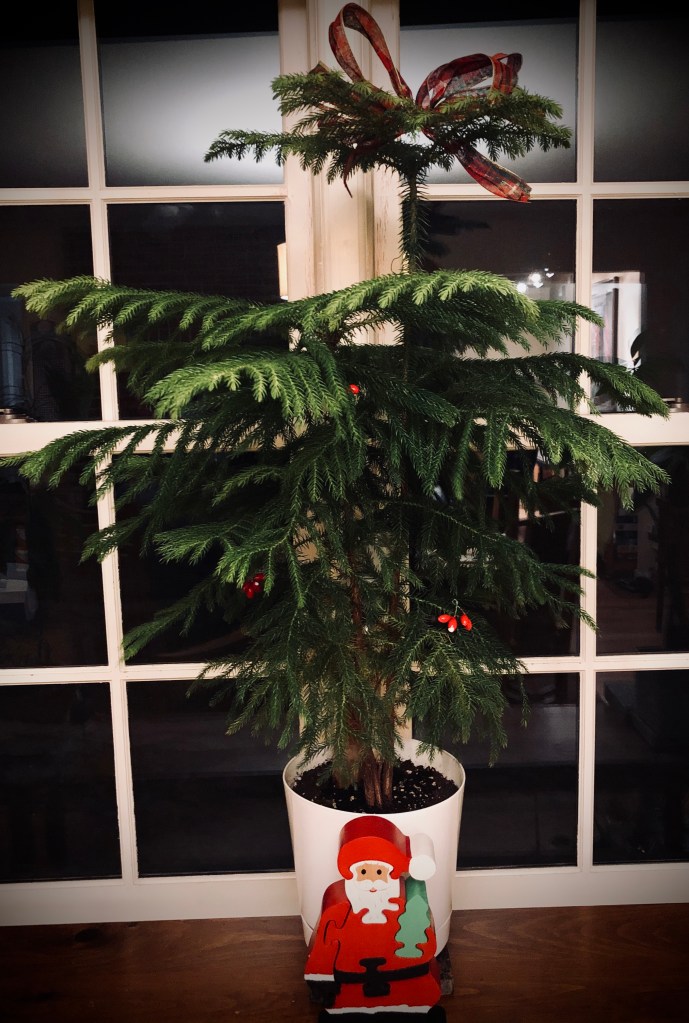
Receive a gift with a festive ribbon? Save that for next year to spruce up a potted plant. Santa decorations and reindeer sculptures can be stored in a closet then re-displayed for years to come.
Gibbs, the Norfolk pine, is feeling quite dapper with his jaunty holiday bow
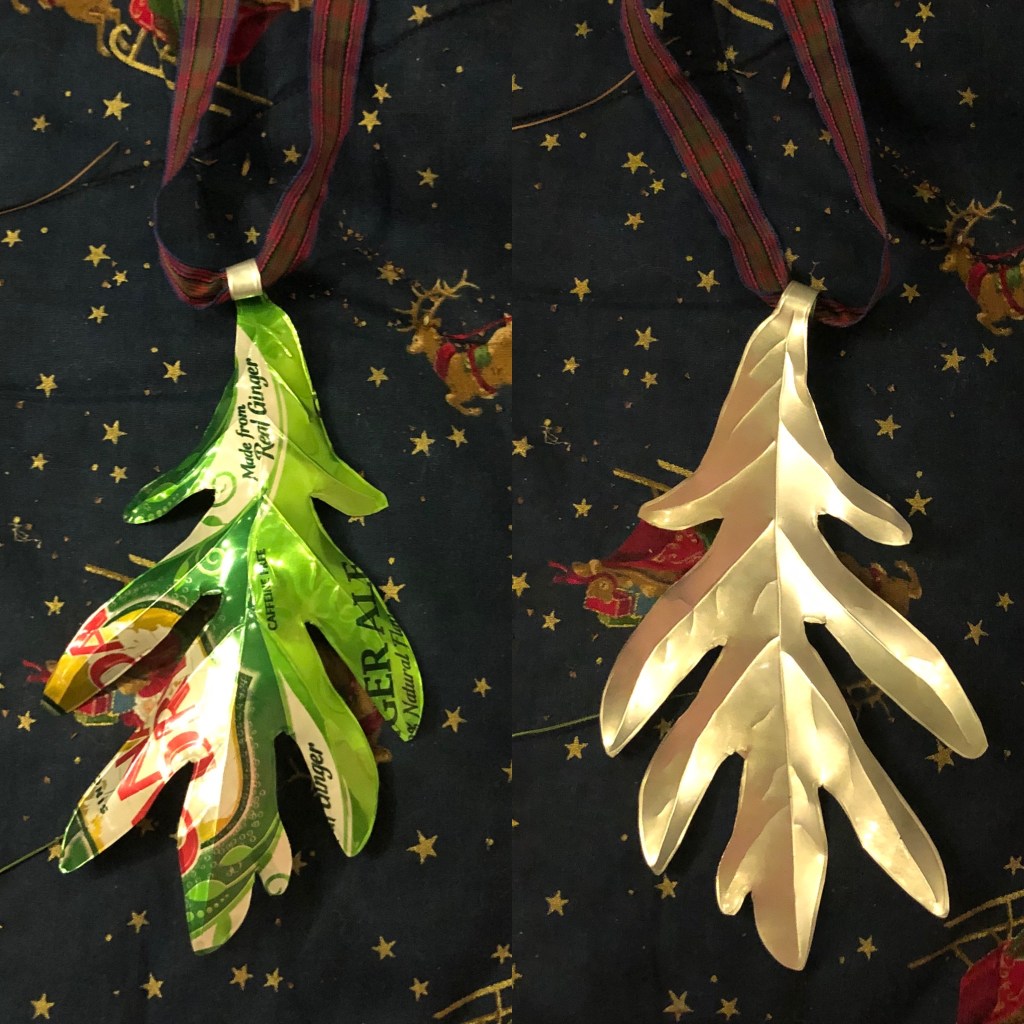
You can also take this opportunity to hone your green thumb by blooming a deep red amaryllis or displaying a poinsettia. If you’re the crafty type, cut out paper snowflakes using scrap paper and hang them on windows and walls. Transform soda cans into festive ornaments for your tree or a friend’s tree. Then, simply stand back to admire your handiwork and holiday spirit.
White oak leaf ornament made from a ginger ale can by a dear friend
The Gifts.
Do you love handmade or experiential gifts? Do you just want cash because you are super picky and hard to shop for? Would you prefer a charitable donation be made in lieu of a gift (or no gifts at all)? Whichever option speaks to you, making your priorities and wishes known will help reduce waste in the long run. Clothing returns require nightmarish reverse logistics during the rest of the year – I can only imagine the process after the holidays. You can reuse wrapping paper and gift bags (or use old newspapers or magazines to wrap presents) to divert even more waste.
TheGiving You may recall my love of take-out Thai food from the low-waste eating post. I’d like to add one more upcycling idea here: a gift for the eco-warrior mom that never orders delivery, but loves the size of those plastic rectangles for picnics & leftovers. Wrap your various, sturdy take-out containers in a reusable cloth bag and place under the tree to open on Christmas morning. When my mom opened that bag you’d have thought she had won the lottery. She reused those containers for years to come.
TheReceiving A few years ago, I discovered a younger cousin’s interest in sustainability and the environment through Christmas gifts that I received from her. She introduced me to Stasher bags and the MakeUp Eraser, to name a few. We now exchange sustainable living ideas on a regular basis. What started as a gift became an ongoing conversation.
What are other ways that you can create less waste and be a more conscious consumer over the holidays without becoming a Grinch?
A Few Holiday Gift Guides (in no particular order):
When the frost sets in, the mice come out. (First frost at the summit of Cannon Mountain, NH)
“First of all, this is perfectly normal and can happen to anyone.”
This was the mechanic’s response to my distress call about the mice that had invaded my brand new car last week. Indeed, these words did make me feel better as he detailed how to take back my car and prevent it from ruin.
Before I dive into mouse vs. car, let’s rewind to the end of the summer (the pre-mouse era). As it became clear that I may be living outside of a city for awhile, I decided to purchase my first car (!). For years prior I had been a subway and yellow cab loyalist. Not only was owning a car in a city expensive, but taking public transportation lowered my carbon footprint.
I wanted to find the car that was right for me. That was, shall we say, on brand. I googled “all-wheel drive cars with best gas mileage” to find a list of contenders (AWD was non-negotiable for me, due to an experience in a 2WD car involving a snowstorm and a torn off bumper). Top of the list: the AWD Toyota Prius.
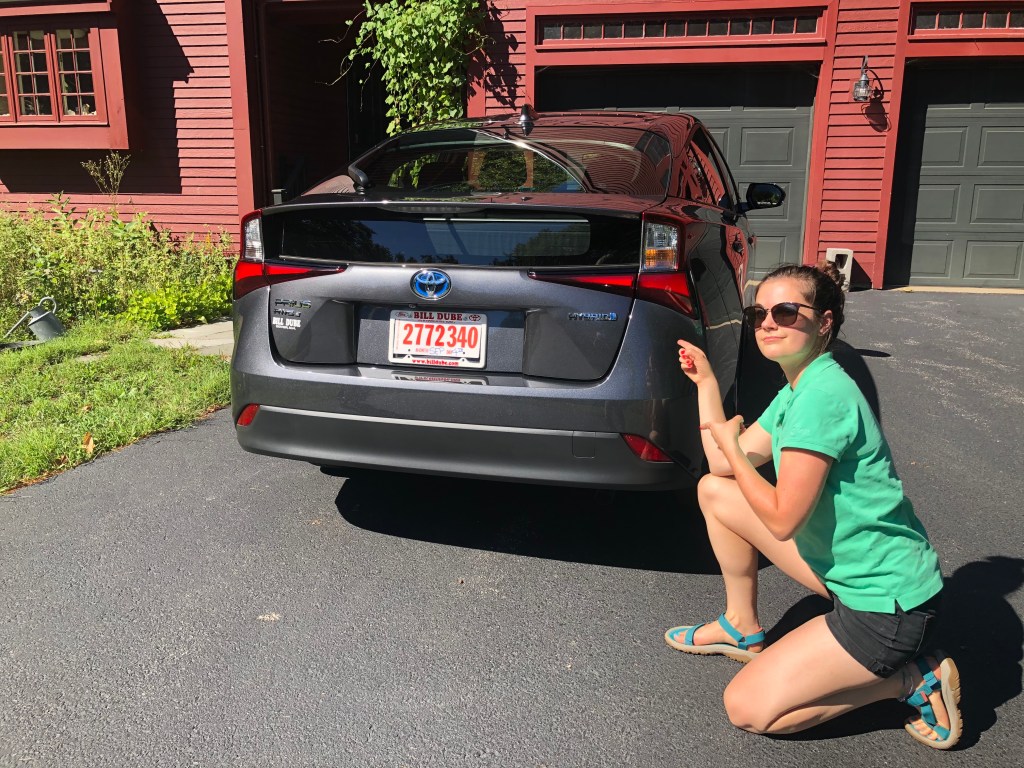
Lupita the Prius comes home!
I test drove a few cars on a Monday, and four days later I was the proud owner of a car that boasted 50+ MPG AND that I could drive to the mountains! I could be respectful of the environment and enjoy nature in all weather conditions! As a nerdy bonus, I got to experience Toyota’s legendary operational efficiency, about which I had read many business school cases.
I knew that eventually I would get a dent or be rear-ended or hit a deer (#mainelife), but in the meantime I was enjoying the honeymoon period with my shiny, clean hybrid vehicle. Little did I know that the honeymoon would be cut short by tiny, woodland creatures.
Mice can total a car. Because of the electric engine, hybrid vehicles contain many tasty wires for mice to chew on. This high-tech, engineering marvel can be taken down by a mouse. I bought this particular car in order to be environmentally-friendly, and it ended up housing mice for a few days — I hadn’t planned to be THAT friendly to the animals.
I couldn’t believe that mice had entered my indoor space. A car is a place for humans and pups only, I thought (and still think, mind you). We try to choose when we interact with nature, but so often that interaction is out of our control. There is a line that should be drawn, but the mice didn’t know that. They were just looking for a warm place to nest as the first frost swept in. As human beings, we take over natural habitats by building houses or even just walking in the woods. But when nature enters our space uninvited? That’s unacceptable to us.
Mother Nature can take care of you and she can destroy you. Hurricanes. Blizzards. Wildfires. The list of natural disasters goes on, but don’t forget the smallest members of the animal kingdom that can also cause irreversible damage. Consider the mouse.
I had been planning to write an entirely different blog post this afternoon. However, an hour at the mechanic and 3 hours of cleaning and mouse-proofing the garage and my car gave me ample time to think about how we can take every precaution to keep nature out, yet we can’t control the wild.
May 2020: Favorite second-hand purchases became part of my daily wardrobe. Leftover fabric was made into this mask.
Pre-2019: Background of the New Year’s Resolution
I’ve been dressing myself since age 2. Much to my mom’s (the anti-shopper’s) chagrin, I desired to find a personal style quite young (I wish I still had that tie-dye tank dress from age 4…).
This love for beautiful clothing blossomed while I was living in Manhattan. I would pop into Bloomingdale’s on the way home from work, or add clothes to my cart on jcrew.com via my phone. This was not the best habit for the earth or my wallet. I knew it would take a drastic change to upend this routine.
On New Year’s Eve 2019, I resolved to abstain from buying new clothing for the entire year. By “new” I really meant “virgin” or “first-hand” clothing — I wanted to become more thoughtful and creative with my purchases. I had no idea whether I would succumb once springtime arrived and the flower-printed sundresses appeared in the window at Bloomie’s, or if this would be the easiest resolution I had ever made.
Before I recount my sartorial successes and failures that year, I’d like to explain what spurred this resolution in the first place.
The fashion industry has a waste crisis, and we, the consumers, play a large role.
It is easiest to blame the fast fashion brands, as they produce and sell cheap clothing at an unsustainable pace. However, the entire apparel industry has an environmental crisis on its hands at all levels of the value chain. As consumers, we have control over the purchase and the end-of-life of our favorite chambray button-down. That is, we choose whether to sew a button back on, mend a hole, or buy an entirely new shirt.
Apparel production is resource intensive. When you buy a brand new pair of jeans, the cotton threads may travel across the globe to be processed into denim, then shipped thousands more miles to the mall near you (see this fascinating Planet Money podcast to follow the production of a t-shirt around the world from cotton farm to textile factory to sewing machine). Plastic and cardboard packaging surrounds this clothing at different points in the value chain as well.
Post purchase, both clothing returns and disposal methods pose major environmental challenges.
Burberry came under fire for burning excess merchandise in order to limit access and maintain “brand value.” Sadly, they are not alone in irresponsibly handling overstock and returns.Many companies have not organized the reverse logistics necessary to accurately process returns. So, they trash perfectly new clothing instead of implementing a more responsible return & resale process.
Do you remember the devastating garment factory fire in Bangladesh about a decade ago (which is one of many such examples)? The pressure to churn out new styles every month has a serious social cost as well.
Thankfully, the industry is reckoning with these challenges. There has been an explosion of articles and advocacy promoting the inclusion of fashion in a circular economy, such as this new series from CNN and the Ellen MacArthur Foundation’s efforts to Make Fashion Circular. However, this is merely the start of a long journey towards circularity and sustainability.
As 2018 was coming to a close, I needed to confront the fact that my current shopping habits and my desire to produce less waste were not compatible.
2019: The Resolution
So, back to the New Year’s Resolution. Was it a smashing success or resounding failure?
Well… if success involves learning and changing habits, I would tip the scales towards success. I already mended clothing myself (stitching holes in seams, re-attaching buttons, etc), and donated old clothing, so my main challenge was my shopping patterns. I permanently unsubscribed from all of the sales updates from my favorite clothing brands and successfully avoided them for all of 2019 (go me!). Below are a few additional highlights.
Highlight #1 I discovered how easy it is to shop at online resalers! When that mid-spring shopping urge appeared when the weather warmed up (as I knew it would), I checked out www.poshmark.com to see whether anyone was selling a gently worn denim jacket. A week later, I was the proud owner of a soft, black denim j.crew jacket that I now wear all the time (see cover photo). Companies like Poshmark and Thredup (amongst others) have streamlined the second-hand shopping process.
Highlight #2 At the end of 2018, when a business school ski trip (with costume parties every night) rolled around, I resisted the temptation to order everything with one-click, and instead weeded through Goodwill with my friend Amy. We found some *fabulous* costumes for not one, but four themed parties (including piecing together a Zenon Girl of the 21st Century costume and a neon 80’s outfit- they were out of this world). The “Six Flags Over Texas” lime green fanny pack (see cover photo) became my most convenient accessory this spring and summer.
Cheat #1 I did let myself cheat. The major exception to my resolution was a week-long backpacking trip in Patagonia, for which I needed proper gear. I decided that brand new hiking boots and hiking clothing were a worthwhile investment that were necessary for both survival and comfort.
Cheat #2 This had less to do with survival, and more to do with meaningful moments: I allowed myself to buy group t-shirts and branded gear (#bschool #bacheloretteparties) if I thought I would *actually* wear the item, and it wouldn’t end up in the next donation pile. For me, the memories were worth it.
2020: The Lingering Effects
Reduction, Resale & Rental I now shop less for clothing, period. When I do have my eye on a new tie-dye sweatshirt (really though, how do the targeted instagram ads read my mind like that?), I first look at second-hand or vintage options (check out A Girl From the North Country for curated vintage clothing and hand-dyed goods). For weddings and formal events in 2019 I wore dresses from my closet, but rental companies like Rent the Runway are on my radar for future events.
Repair & Refurbishment Either finding a great tailor/seamstress or learning to mend clothing yourself is one of the keys to prolonging clothing life. Also, did you know that most clothing items don’t actually need to be drycleaned? The Laundress interview on How I Built This was a fascinating look at eco-friendly alternatives to the dry cleaner. Avoiding the dry cleaner and the dryer also extend closet life. My mom has always hang-dried her clothing, and her 30-year-old t-shirts are still in top shape.
New Clothing When I do decide it’s worth purchasing a brand new item, I consider whether the clothing brand is a B. Corp, uses natural or organic fabrics, maintains ethical working environments, etc. It can be tough to know which new brands are the real deal, and which have excellent marketing campaigns but no substance. Many consumers and journalists had the same question, so a bit of online research can turn up a fair amount of information on popular brands. Buying well-made clothing may be more expensive, but it should last longer (see a Booth classmate’s ChiBus article on sustainability and personal style).
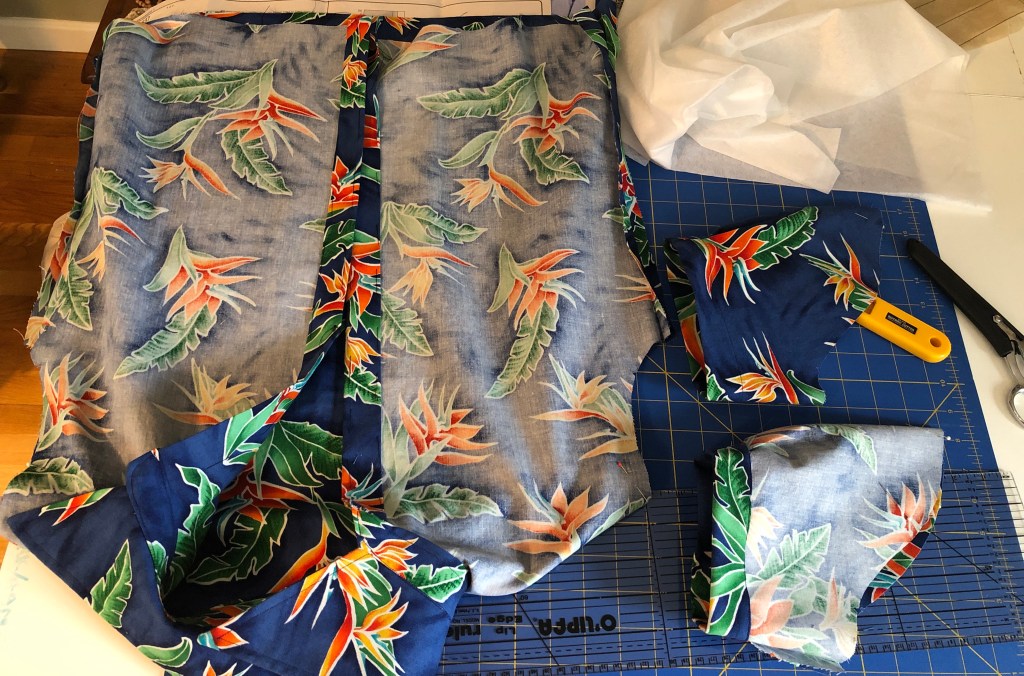
April 2020: When I discovered this fabric had been sitting in the closet for years, I knew I had to make my first shirt out of it.
Next Goal: Sewing Maven Since I’m often at home these days, I started sewing my own clothing! I just acquired a sewing machine (with over 120 stitches!), and I am already obsessed. It’s so satisfying to wear or gift clothing that I’ve made myself — even if the collar doesn’t turn out exactly how I pictured it (see above & below for Project #1). Although new fabric is involved, I’ll try to purchase from the local fabric store that my family has been visiting since the 1980s. I hope this clothing will last and last (although that aspect will completely depend on my skill level – wish me luck), and that I’ll acquire new mending and alteration techniques along the way.
The final product out on the town! (Yes, I admit to sipping iced coffee from disposable plastic here)
Here’s to the compatibility of personal style, creativity, and low-waste closets. May our wardrobes be forever sustainable and satisfying!
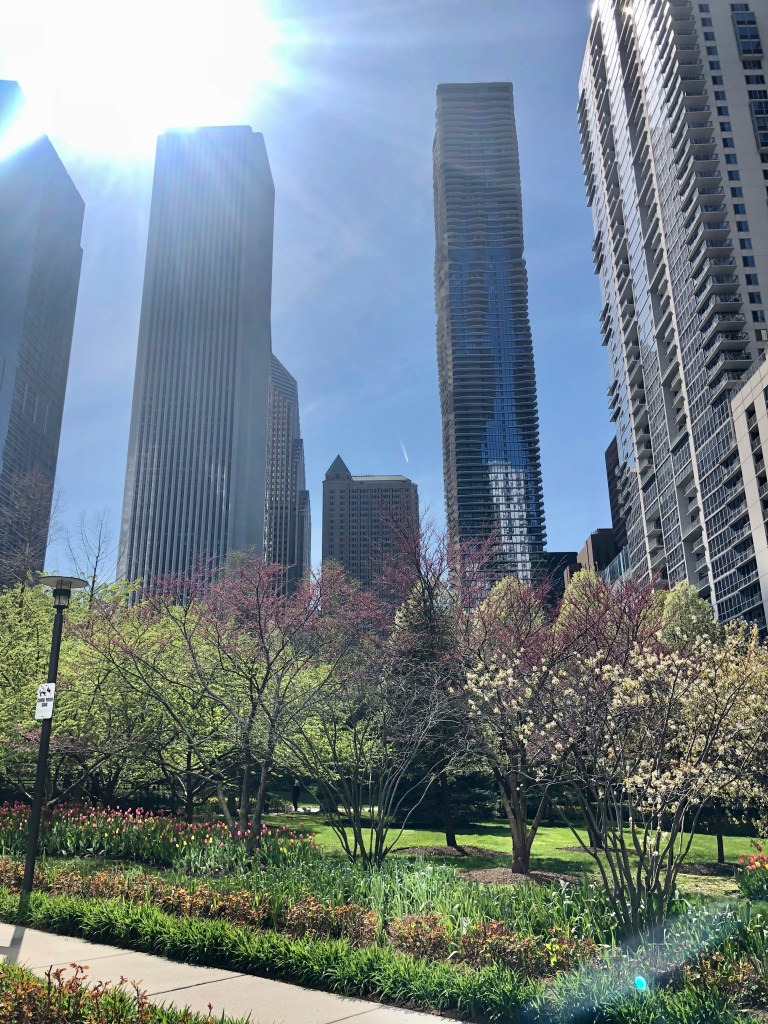
Blooming trees and skyscrapers (aka Springtime in Chicago)
You know those cheery sales people that you try to avoid eye contact with? Well, thank goodness my friend Noelle stopped to speak with the alternative energy rep at the farmers market back in 2014, or we wouldn’t have discovered the sustainable electricity options at our fingertips.
After that fortuitous encounter, I opted for renewable energy sources for my Upper East Side apartment. My choice felt (literally) powerful. I was relieved to know that the electricity I used wasn’t produced by pollution-causing sources. It also made me wonder: what else in my apartment could I change to be more sustainable?
It can feel like so much is out of our control when living in an apartment. We’re told exactly which utility company to pay. Appliances come with the apartment and may not be the most efficient. Our landlords control the rest of the building. However, we have control over what we bring into our apartments, and how we dispose of items on their way out. (Those discarded Amazon boxes stacked in the corner did not magically order themselves, and cannot teleport to the recycling.)
Where can I start, you may ask? This post will give introductory tips on how your apartment and living space itself can be less wasteful. The mantra of reduce, reuse, and (of course) recycle applies. Remember: whatever you bring into your apartment, will eventually have to go out.
WHAT GOES IN…
Be mindful of what you bring into your living space
Below are the main categories that apply to most apartments. Think about what else is a mainstay in your living space — Clothing? Art supplies? Food? Video games? Books? Get creative in finding other ways to be more sustainable!
Electricity You know whether your milk is organic, but do you know where your electricity comes from? This is easily overlooked as an apartment dweller, but many electricity providers offer a renewable energy option. The default for electricity in many areas is still fossil fuels, which contributes to climate change. This article offers easy steps for how to find out if you can switch to renewables in your state/city. In many cases the cost is comparable as well.
Water Yes, you can still have that lovely bubble bath, but there are many ways to be smart about your water usage and have good habits (especially if you live in a drought prone area). There are common-sense tips such as: don’t leave the water running while brushing your teeth; only run the dishwasher and washing machines when you have full loads; don’t take hour-long showers, etc. Recently, I discovered this neat dishwashing trick from Bon Appetit, which seems great for someone (like me) that wishes that dishes could wash themselves.
Appliances Both energy and water efficiency depend on the appliance itself. When buying new appliances, look for the Energy Star efficiency label, or google search the leading models. Not only is efficiency better for the environment, but it will save you money each month on water & electricity bills. I call that a win-win!
For appliances that came with your apartment, make sure they’re full when you run them and that they are running at full capacity. (For example, I learned late in life that you have to clean the air filters on window AC units both for optimal performance and for health reasons… whoops!)
Furniture I love interior design. Admittedly, I have taken the easy way out and ordered from Ikea and Wayfair, but there are so many other options. New, cheap furniture is resource intensive to make, and doesn’t last that long — that broken Ikea shelf doesn’t serve much purpose in a landfill. Buying pre-owned furniture can be a fantastic option.
If you’re looking for something specific, try Craigs List or Facebook Marketplace. Another option is AptDeco, which allows you to search for specific items and even takes care of delivery. If you’re in the mood to browse in person or if you’re on a budget, Goodwill, Salvation Army, or the local thrift store can serve up some gems. For special pieces, see if there are antique stores near you (if you’re from New England, you’ll know “antiquing” is a thing).
… MUST COME OUT
Dispose of waste in the most eco-friendly way
It amazes me how often I have to take out the recycling and how full my compost bin gets. Although I’d rather have less waste of all types by reducing and reusing, my secondary goal is to take out recycling and compost more often than trash to the dumpster.
A key to the disposal step is to organize your waste receptacles to make it easy on yourself. I suggest the below categories.
Recycling (either separate bins or single stream)
Some areas recycle plastic/glass/paper together, while others require you to separate everything. The Recycling Partnership and Waste Management both have Recycling 101 guides to make things easier for us.
Compost
I could talk about the importance of composting for hours, but I’ll be brief. Food waste is estimated to make up about one third of landfills. In landfills, that rotting food produces greenhouse gases which contribute to climate change. Alternatively, when food scraps are sent to be composted, the harmful emissions are avoided AND the compost can then be used to grow delicious food (circle of life, anyone?)
There are multiple composting options available. The options, like electricity and recycling, differ city to city. The three main options to research are:
City pick-up: your municipality may offer food scrap pick-up along with trash & recycling pick-up.
Drop-off sites: This could be a private, non-profit, or municipal organization that has drop-off sites at local restaurants or farmer’s markets.
Private composting company: in many cities that do not compost, companies exist that will pick-up your food scraps for a fee.
Compost at home: I have not personally tried this in an apartment, but odorless options (as explained in this NYT article) do exist.
Donate or Sell
Keep a “give-away” box in your closet to which you add old clothes and chachkis
Once it’s full, you can either:
Host a clothing swap with friends
Donate to a thrift store
Find a textile recycling for those items that have seen better days
Trash
The last resort. See how small of a trash bin you can get away with!
There is always more to think about, but hopefully this list provides a straightforward way to start. Also, a little bonus idea….
BONUS: Small space gardens! I love house plants, but I have not gone full garden yet. This is on my personal bucket list. Small-space and indoor gardens (or windowsill/fire escape gardens) are a cool option. Check out companies like Aero Garden for growing your salads at home.
If you had to choose between an actual oven in your apartment and a washer/dryer, which would you choose? When I moved to New York City in my early 20s, I discovered that most apartments were too small to have both. So, in order to roast vegetables in winter and bake zucchini bread in summer, I chose the oven. That meant I had to walk two blocks and three flights of stairs to a laundromat.
You can see my priorities are more in my belly than caring if strangers saw my ripped sleep shirts.
It all comes down to food. Not just because I love to eat fresh ingredients from the farmer’s market, but because how I prepare and consume food directly relates to how much waste I generate. Even if you’re blissfully ignorant of the consequences of your waste, you’re likely quietly aware of how often you take out the trash. Did you know that the methane released by rotting food in landfills is a significant contributor to greenhouse gas emissions and climate change? I was very surprised when I learned this fact. (Turns out the one thing I thought was always compostable, when disposed of in the wrong way, ends up doing more harm than good!)
Despite my love of cooking, in the city I discovered I could order take-out Thai food at the click of a button.
I also discovered the convenience of popping into one of the many Starbucks for an iced coffee. But where the heck were all the recycling bins?
Coming from the woods of Maine, I didn’t think as much about these topics. I grew up in a house with a large vegetable garden, a compost, and chickens. We could pick blueberries for breakfast and cut fresh lettuce to make our salads for lunch. If we forgot about leftovers for a few days, the chickens would happily eat them (they will eat almost anything). It was idyllic and delicious, and I thought only possible in Maine.
As I learned more about the effect of our consumption choices, I wanted to figure out ways that I could eat in New York (or any city for that matter) without feeling a nagging guilt that I was hurting the environment with each bite. Although I was inundated with messages of how to be a more conscious eater, it was hard to make sense of how it could be possible in a city with a full-time job.
This is why I’m serving up my three simplest tips for reducing your food waste, while eating really well too.
Step 1: REDUCE! Less can really be more
Eat less meat by eating your colors (no, meat is not a color) You have probably heard of the meatless Monday. Given that animal agriculture uses nearly half of the world’s land, contributes to about 15% of global greenhouse gas emissions, AND uses about 25% of the world’s freshwater, there are very good reasons to eat less meat. I became a vegetarian 10 years ago after learning these figures, but I know that going cold turkey isn’t for everyone.
The key is to find superb meals that happen to not include animals. The more colorful the dish, the better. I’ll bet there are certain foods you love that you didn’t even realize are vegetarian. Some of my go-to recipes include:
When you do eat meat – buy responsibly! Check out what your local farmers are raising this year by asking at the farmer’s market. I’ve heard rumors that well-raised meat tastes better.
(Okay, okay, I may have tested out that rumor myself. I finally sampled the organic chicken and pork that my dad raises at his small farm. This jury of one vegetarian had to admit — happy animals lead to happy palettes).
Only buy food you will gladly eat I was shocked to learn that discarded food makes up almost a third of landfills. But city grocery shopping is logistically challenging, especially if you live far from a grocery store or in a walk-up building. It’s easy to overshop and end up with spoiled food. For the love of mother earth – don’t buy that bunch of kale for the hundredth time just because that influencer says to. Buy something that *you* think is delicious! Don’t forget about your freezer either – many dishes can be frozen and enjoyed later. Plus, if you can compost in your area, it’s worth it.
Use less take-out containers Home-prepared meals save money AND cut down on excess packaging. Period. But, if you’re going to visit a restaurant, note their food packaging. Restaurant take-out containers run the gamut from straight-to-landfill (styrofoam), to recyclable plastic, to biodegradable/industrial compostable. When you do opt for take-out, notice the type of packaging that your favorite spots use. Let them know what you think of their packaging – your customer voice matters.
Step 2: REUSE! (you may sense a theme…)
Reuse take-out containers at home Never buy tupperware again. When you do get take-out, save that packaging! You can use it for leftovers, freezing homemade food, storing pens or lipstick – endless possibilities. If you mostly shop at the grocery store, see what packaging can be reused or recycled.
Reuse containers and bags at the store Bring reusable containers and bags when you go grocery shopping. Admittedly, I forget reusable/recycled produce bags often. In that case, I just let the lemons roll around my basket (they’re pretty resilient!). If you are running home from work (hypothetically, when we went to work in person): keep a small foldable bag in your backpack or purse. It may not hold everything, but it will cut down on excess baggage. If you order groceries delivered: reuse those paper or plastic bags. I have never bought small garbage bin liners in my life (humble brag), and instead I use those plastic bags.
Step 3: Bon Appetit! Buen Provecho! ENJOY!
Cook with friends (together and apart) Learn to cook! Take on simple recipes, then graduate to more complex ones. In a small kitchen, one-pot meals are a great option. If the word “cooking” intimidates you – how about learning to assemble a nice cheese & fruit board? Unpack the cheese, cut some fruit, put crackers in a nice circle, et voila! Your friends will be so impressed.
Ideas for enjoying your culinary talents:
Dinner parties at home, either around a real table or BYO pillows for sitting on the floor
Picnics on a sunny day
Prepare the same recipe with friends via video chat, then dine “together” and enjoy the delicious food you’ve made. Even apart, you can savor the same flavors!
Bonus idea: Farmers Market Brunch Tired of spending $40+ on eggs benedict and a bloody? (Remember when you used to do that?) An alternative is an outing with friends to the farmer’s market. Check out what the locals are cooking – there might be muffins with orchard-fresh fruit, or breakfast burritos with eggs from the farmer’s chickens. You can eat while browsing the abundance of farm stalls. See what looks good, and buy those ingredients for dinner. Friends, grocery shopping, and sunshine all rolled into one outing. What’s better than that?
In conclusion, you can revise your food shopping, meal planning, and waste disposal to meet your values – your palate will love it and mother nature will thank you.








 Sarah Clark-Hamel